

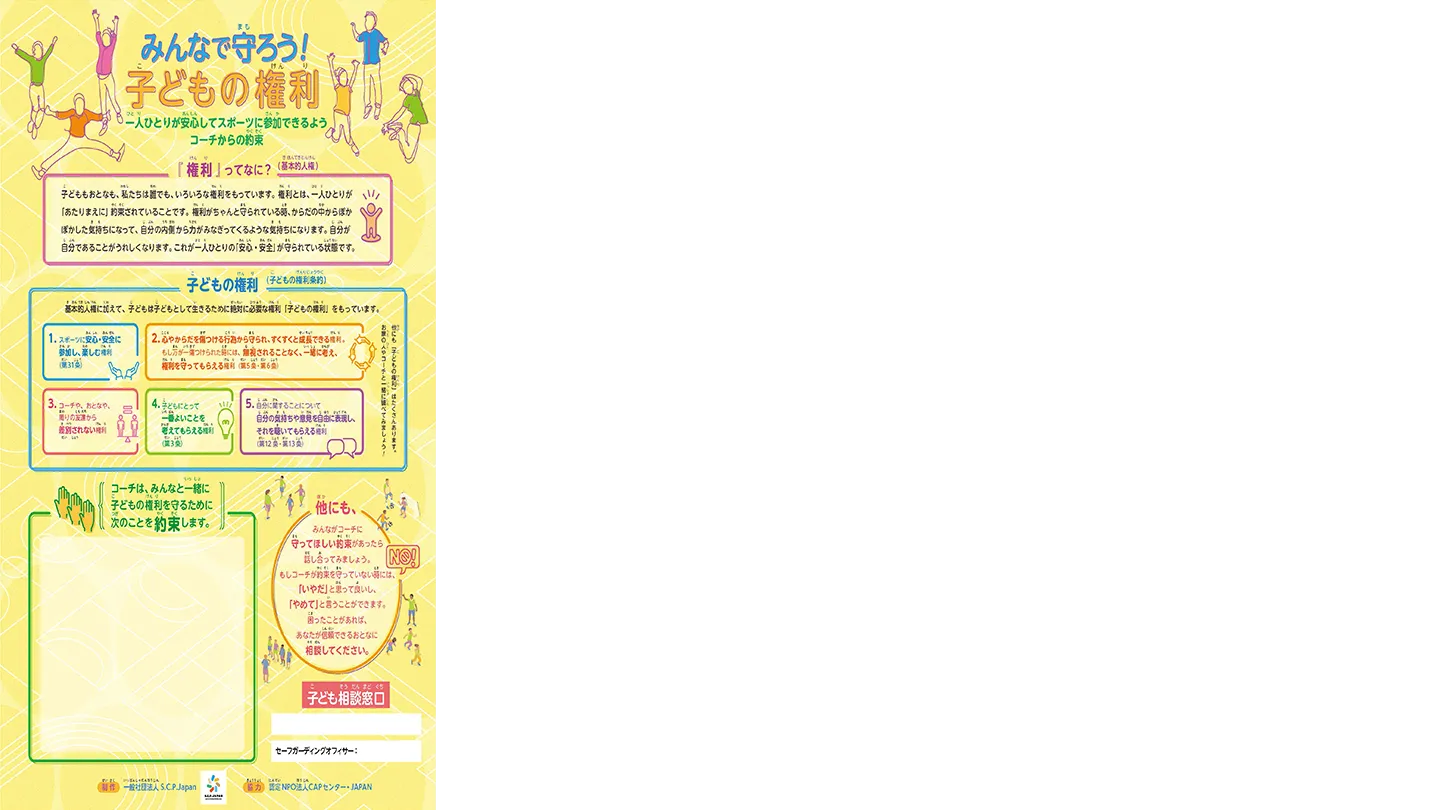
【みんなで守ろう!子どもの権利】スポーツ現場における子どもの安心・安全を守るための「コーチからの約束」をまとめたリーフレットが完成! 【Let's all protect children's rights!】 A leaflet summarising ‘Coaches' Pledges’ to safeguard children's wellbeing and safety in sports settings is now complete!
(リーフレットは、本ページの下部より、どなたでもダウンロードして使用可能です。)
一般社団法人S.C.P. Japanでは、スポーツに参加をする子どもたちの安心・安全を守るための取り組み(子どものセーフガーディング *1)を、これまで様々な形で進めてきました。
(※1)子どものセーフガーディングとは:
関係者による虐待や搾取など、子どもの権利に反する行為や危険を防止し、安心・安全な活動と運営を目指す組織的取り組みです。疑念が生じた場合の対応と再発防止も含む包括的なものです。(セーブ・ザ・チルドレン・ジャパンHPよりhttps://www.savechildren.or.jp/about_sc/quality1.html)
この度、スポーツ活動中、「子どもの権利」を守るためにするコーチからの約束を、子どもたち・保護者の皆さんにも知ってもらえるよう、リーフレットを作成いたしました。 本ページの下部には、スポーツの活動をされている他の団体・組織の皆さんにもご活用いただけるバージョンもご用意いたしましたので、ぜひ多くのスポーツ関係者の方々にご活用いただけますと幸いです。
「コーチからの約束」リーフレット(S.C.P. Japan バージョン)
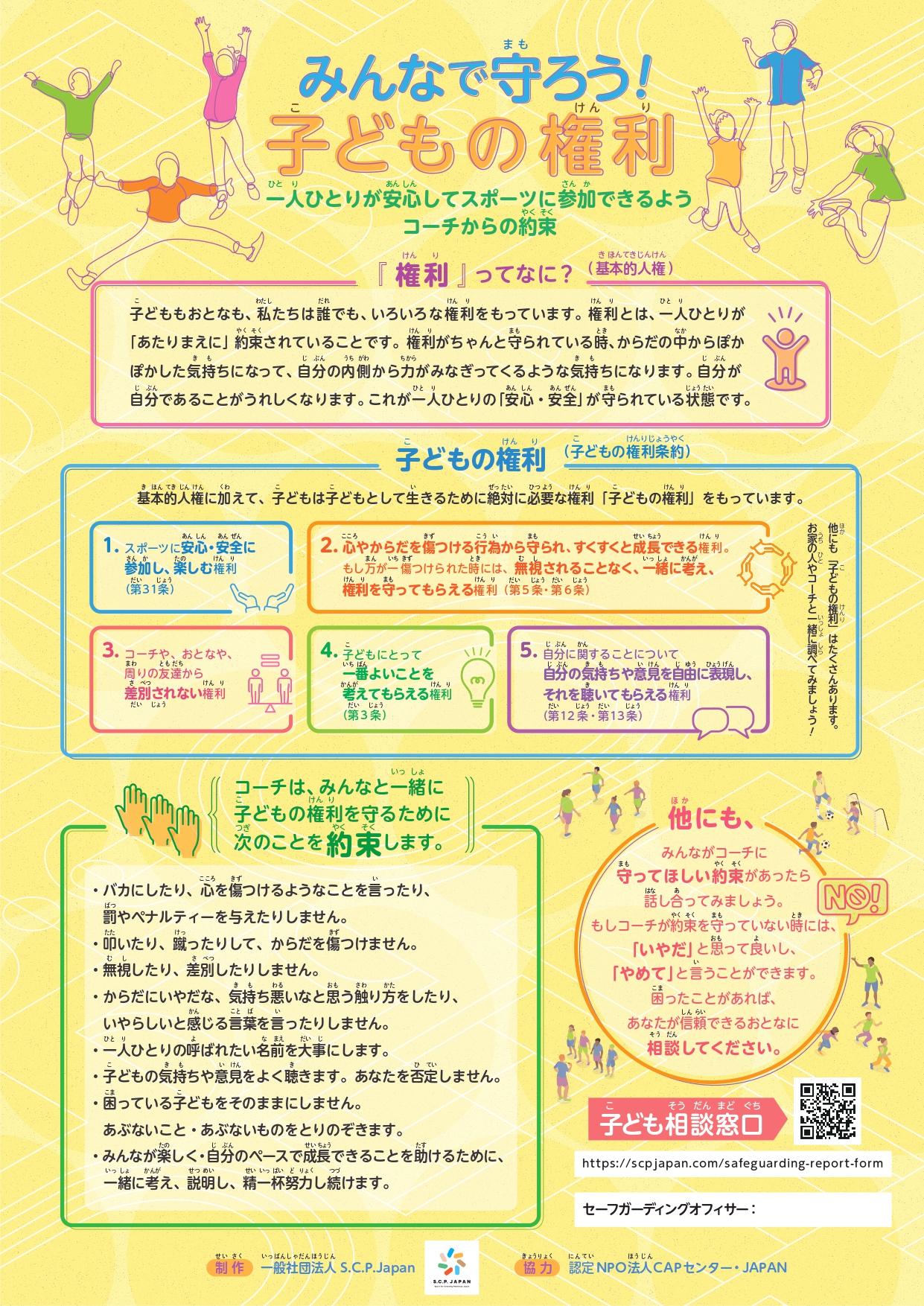
S.C.P. Japanでは、このリーフレットを活用し、活動に参加をするすべての子どもたちに、「子どもの権利」と子どもの権利を守るための「コーチからの約束」について説明し、知ってもらえるようにします。そして、この約束がきちんと守られているかを子どもたちと常に見直し、子どもたちの力を借りながら、安心・安全な活動環境をつくっていきたいと思います。
<S.C.P. Japanでの主な活用方法>
●定期的な活動では、年度はじめなどに子どもと保護者にリーフレットを配布し、内容の説明と、セーフガーディング担当者についてお知らせします。その後、いつも見えるところにリーフレットを掲示し、定期的に「コーチからの約束」を子どもたちと一緒に振り返ります。
●単発のイベントでは、申し込み段階から、参加者の皆さまに安心・安全なイベントであることが伝わるように、告知チラシの裏面などにこちらのリーフレットを掲載します。イベント当日は、受付にてリーフレットを配布し、活動前に目を通してもらったり、説明をしたりします。
●活動に参加をしてくれている子どもたちと話し合い、必要に応じて約束の内容を変えていきます。
スポーツの活動で子どもと関わる皆さんへ
今回他団体様の活動でもご活用いただけるよう、こちらのリーフレットをダウンロードして、ご利用いただけるようにいたしました。以下のお願い事項を守っていただき、ぜひ子どもにとって安心・安全なスポーツの環境を一緒につくってくださると嬉しいです。
<リーフレットをご活用いただく際のお願い>
●活動に参加をする子どもとおとなとが話し合い、皆さんの「約束」を定めてください。
●このリーフレットを配布・周知することは、子どものセーフガーディングの取り組みのほんの一部であり、これによって子どもにとってのあらゆる危害をすべて防げるわけではありません。この他にも組織でやるべきセーフガーディングの取り組み(ポリシーや行動規範の作成・運用、相談窓口、スタッフ向け研修など)を可能な限り実施できるよう努力していってください。
●組織全体、または、各活動で、セーフガーディングの担当者を最低一名は必ず設けるようにし、子どもにもわかるようにしてください。(ただし、セーフガーディングに取り組むことは、組織に関わるすべての人の責任です。セーフガーディング担当者のみの責任ではないことにご留意ください。)
コーチからの約束(ダウンロード・他団体様用)
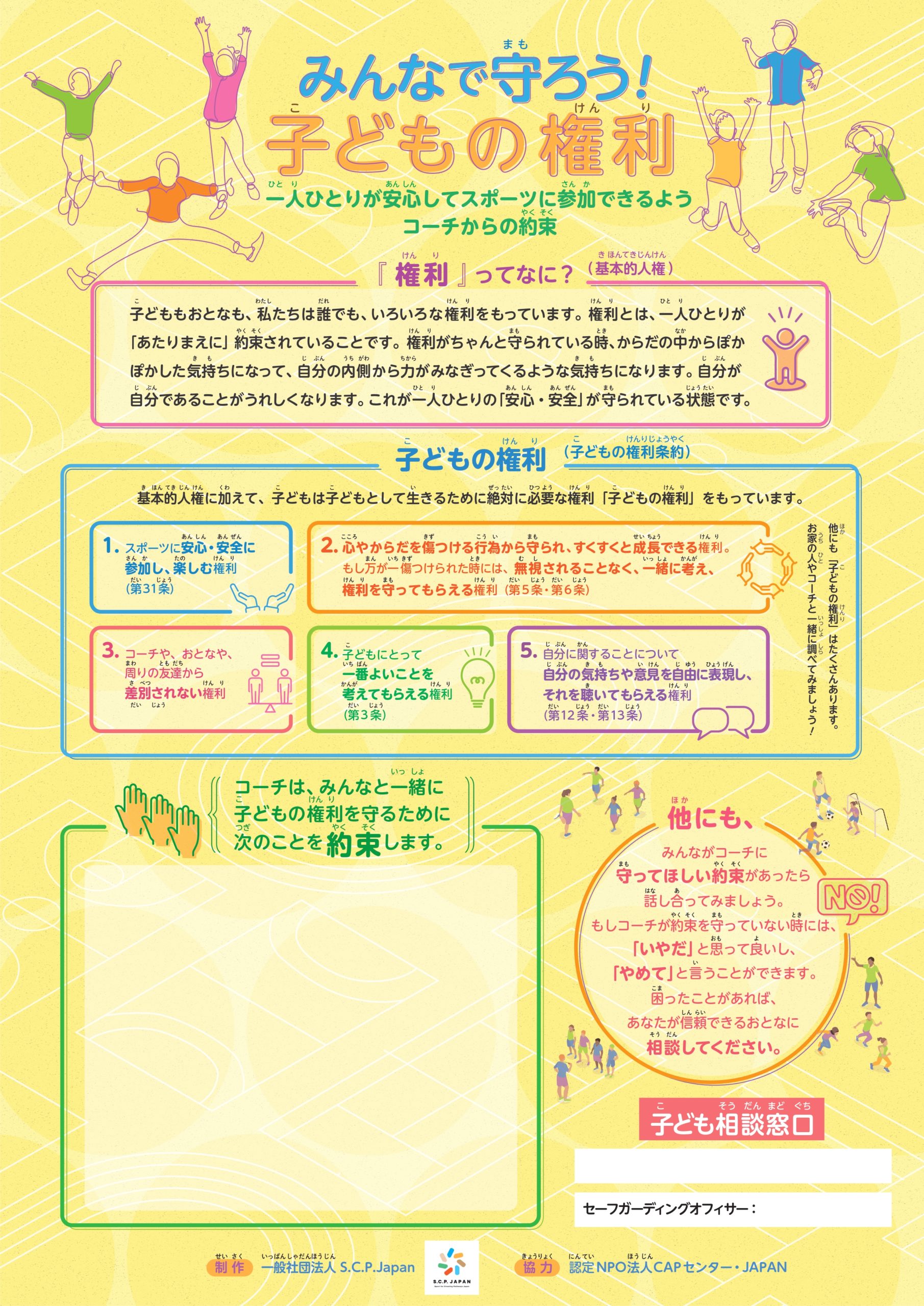
【PDF ver. ダウンロード】【JPEG ver.ダウンロード】【Power Point ver. ダウンロード】
S.C.P. Japanでは、このリーフレットを作成する際、「子どもの権利」の専門団体である認定NPO法人 CAPセンター・JAPANさんからフィードバックをいただき、たくさんの大切なことを教えていただきました。そこで学んだことを「活用の際に大事にするポイント」としてCAPセンター・JAPANさんの許可を得て、以下に記載させていただきます。このリーフレットを活用いただく皆さんも、どうか「配るだけで終わり」ではなく、「子どもの権利」についての理解を深め、子どもの話を聴き、説明し、対話を大事に活動をしていっていただけたらと思います。
【本リーフレット活用の際に大事にするポイント】
●このリーフレットは、一人ひとりの子どもを権利行使の主体とし、一人ひとりの子どもの権利を平等に保障するという理念を土台に作成し、運用するものです。
●「コーチ(おとな)からの約束」という位置づけとなります。子どもが守る約束ではなく、おとなが守る約束を述べています。
●子どももおとなも一人ひとり持っている権利(基本的人権)があり、さらに子どもは子どもとして生きるために絶対に必要な権利「子どもの権利」を持っています。
●あえて「大人」を「おとな」と表記することに大きな意義があります。「大きな人」と表記するのではなく、「おとな」と表記し、それを目にすることがおとなにとって優位性からの脱却を図る必要性を認識する分岐点になると考えています。
●「差別されない」とはどういうことかを説明できるようにおとなは準備しなければなりません。文字にすると長くなるかもしれないので、口頭でもよいので説明することは「看板」だけにしないためにもとても重要です。例えば、「人はみんないろいろな部分が違っている。肌の色、身長、体重、できること、できないことなど違っていることはいっぱいある。それは当たり前のこと。なにもおかしいことではないよ。誰かと比べなくていい。それは大事にされていいことだよ」という言い方もできます。
子どもの権利条約の第2条「すべての子どもは、みんな平等に この条約にある権利をもっています。子どもは、国のちがいや、男か女か、どのようなことばを使うか、 どんな宗教を信じているか,どんな意見をもっているか、心やからだに障がいがあるかないか、お金持ちであるかないか、親がどういう人であるか、などによって差別されません。」(子どもの権利条約 日本ユニセフ協会抄訳)差別が何かをコーチが具体的に意識できることが重要となります。
●コーチは、「子どもにとって一番よいことを考える」ときに、子どもの意見を聞き、反映させる、応答する責任(一緒に考えることを含む)」を意識することが必要です。
●子どもの意見表明権(子どもの権利条約第12条)に触れています。おとなは「聴く」だけでなく、「子どもと一緒に考える」「説明する」ことなどを含める応答責任があります。
●セーフガ-ディングでは活動における環境面の安全確保(熱中症対策や、危険物がないようにする、など)も重要な要素です。
●今回このリーフレットに含めることができませんでしたが、子どもにどんな時に相談をして欲しいか、相談して欲しい内容をあらかじめ具体的に子どもに伝えることも大切です。「困ったことがあれば、相談してください」と言っても、子どもにとって「困ったこと」とカテゴライズされてしまうと、その「困った」ということがわからないこともあり、具体例をいくつかあげることが相談しやすい環境に繋がります。(具体的な例:ケガをした/練習に来るのが(参加するのが)つらくなった/他の子やおとなからいやなことをされた・言われた/コーチが約束を守らなかった、など)
●セーフガーディングオフィサー(担当者)に、優位性の強い直接のコーチだけがいるのではなく、その他に目に見える形で担当者が居て、さらに窓口が設けられているということが重要です。
※リーフレット作成時に認定NPO法人 CAPセンター・JAPANさんからいただいたフィードバックをもとに上記のポイントを作成しています。
本リーフレットをご活用いただいた皆さんも、活用しながら気づいた点や、こうしたらもっと良くなる、などのアイディアがございましたら、ぜひご共有いただけると嬉しいです。その他、本リーフレットの活用に関するご質問などお気軽に以下までご連絡ください。
お問い合わせ
一般社団法人 S.C.P. Japan(担当:井上・橋本)
TEL:090-9974-1012/Mail:info@scpjapan.com
(The leaflet is available for download and use by anyone from the bottom of this page.)
The General Incorporated Association S.C.P. Japan has, in various ways, advanced initiatives to safeguard the wellbeing and safety of children participating in sport (child safeguarding*1).
(※1) Child Safeguarding:
This refers to an organisational approach aimed at preventing acts or dangers that violate children’s rights, such as abuse or exploitation by those involved, and ensuring safe and secure activities and operations. It is a comprehensive approach that includes responses when concerns arise and measures to prevent recurrence. (Source: Save the Children Japan website https://www.savechildren.or.jp/about_sc/quality1.html)
We have now created a leaflet to inform children and their guardians about the promises coaches make to protect children’s rights during sporting activities. At the bottom of this page, we have also provided a version that other organisations and groups involved in sporting activities can use. We would be delighted if many sports stakeholders could make use of it.
‘Promises from Coaches’ Leaflet (S.C.P. Japan Version)
At S.C.P. Japan, we will use this leaflet to explain the ‘Children’s Rights’ and the ‘Coach’s Pledge’ for safeguarding these rights to all children participating in our activities, ensuring they understand them. We will continually review with the children whether this pledge is being properly upheld, and with their help, strive to create a safe and secure activity environment.
<Primary Usage Methods at S.C.P. Japan>
● For regular activities, we distribute the leaflet to children and parents at the start of the year, explaining its contents and informing them about the Safeguarding Officer. We then display the leaflet in a visible location and regularly review the ‘Coach’s Promise’ together with the children.
● For one-off events, we include this leaflet on the reverse of promotional flyers from the registration stage to convey the event’s safe and secure nature to participants. On the day, leaflets are distributed at reception for participants to review or receive an explanation before activities commence.
● We discuss the content of the promises with the children participating in the activities and amend them as necessary.
To all those involved with children in sporting activities
To enable other organisations to utilise this leaflet for their activities, we have made it available for download and use. We would be delighted if you could adhere to the following requests and help us create a safe and secure sporting environment for children.
● Please establish your own ‘Promises’ through discussion between the children participating in the activity and the adults involved.
● Distributing and publicising this leaflet is only one part of safeguarding children; it cannot prevent all harm to children. Please strive to implement other safeguarding measures your organisation should undertake (such as creating and implementing policies and codes of conduct, establishing reporting channels, and providing staff training) to the greatest extent possible.
● Ensure at least one safeguarding lead is appointed for the entire organisation or for each activity, and make this role clear to children. (Please note, however, that safeguarding is the responsibility of everyone involved in the organisation; it is not solely the responsibility of the safeguarding lead.)
Coach’s Pledge (Download / For Other Organisations)
【PDF ver. Download】【JPEG ver. Download】【Power Point ver. Download】
When creating this leaflet, S.C.P. Japan received feedback from Certified NPO CAP Centre JAPAN, a specialist organisation in children’s rights, and learned many important points. With CAP Centre JAPAN’s permission, we have included these lessons as ‘Key Points for Use’ below.We hope that all those who utilise this leaflet will not simply distribute it and consider their work done, but will deepen their understanding of children’s rights, listen to children’s voices, explain matters clearly, and prioritise dialogue in their activities.
【Key Points for Utilising This Leaflet】
● This leaflet is created and intended for use based on the principle that each individual child is the subject exercising their rights, and that the rights of each individual child are equally guaranteed.
● It is positioned as a ‘promise from the coach (adult)’. It states promises that adults keep, not promises that children keep.
● Both children and adults possess rights (fundamental human rights) as individuals. Furthermore, children possess ‘children’s rights’ – rights absolutely essential for them to live as children.
● There is significant meaning in deliberately writing ‘大人’ (adults) as ‘おとな’. We believe that writing it as ‘おとな’ rather than “大きな人” (big people), and seeing it written this way, serves as a turning point for adults to recognise the need to move away from a position of superiority.
● Adults must be prepared to explain what it means to ‘not be discriminated against’. As putting it into words might be lengthy, explaining it verbally is also very important to ensure it is not merely a ‘signboard’. For example:‘People are all different in many ways. Skin colour, height, weight, what they can and cannot do – there are many differences. That is perfectly natural. There is nothing strange about it. You don’t need to compare yourself to anyone else. That is something to be valued.’
Article 2 of the Convention on the Rights of the Child states: “All children have the rights set out in this Convention equally.Children shall not be discriminated against on the basis of nationality, gender, language, religion, opinion, mental or physical disability, wealth, or the status of their parents.” (Convention on the Rights of the Child, Japanese UNICEF Association paraphrase) It is vital for coaches to be able to concretely recognise what constitutes discrimination.
● When considering ‘what is in the best interests of the child’, coaches must be mindful of their responsibility to listen to, reflect, and respond to children’s views (including thinking together).
● This touches on the right of the child to express their views (Article 12 of the Convention on the Rights of the Child). Adults have a responsibility to respond, which includes not only “listening” but also ‘thinking together with the child’ and ‘explaining’.
● In safeguarding, ensuring environmental safety during activities (such as heatstroke prevention measures and ensuring no hazardous materials are present) is also a crucial element.
● Although it could not be included in this leaflet this time, it is also important to communicate to children in advance, in concrete terms, when they should seek advice and what matters they should discuss.Simply saying ‘Please talk to me if you have any problems’ may not be helpful, as children might struggle to categorise what constitutes a ‘problem’ for them. Providing several concrete examples creates a more accessible environment for discussion. (Examples: Getting injured / Finding it difficult to come to practice (or participate) / Being treated badly or spoken to in an unpleasant way by another child or adult / A coach not keeping their promise, etc.)
● It is crucial that the Safeguarding Officer (designated person) role is not solely filled by the primary coach, who holds a position of authority. Visible personnel should also be designated, and a dedicated contact point established.
※ The above points were developed based on feedback received from Certified NPO CAP Centre JAPAN during the leaflet creation process.
We would be delighted if those using this leaflet would also share any points they notice while using it, or ideas on how it could be improved. Please feel free to contact us below with any other questions regarding the use of this leaflet.
Contact
General Incorporated Association S.C.P. Japan (Contacts: Inoue / Hashimoto)
TEL: 090-9974-1012/Mail: info@scpjapan.com

